Can I Learn to Surf in Morocco in 3 Days?
If you are thinking about a long weekend on the Atlantic, the honest answer is yes you can learn to surf in Morocco in three days, as long as you are realistic about what “learning to surf” means. Three days is enough to stand up, ride waves under your own steam, and leave genuinely hooked. It is not enough to become an independent surfer. This guide explains exactly what three days gets you, what happens each day, and why the coast north of Agadir is where most British beginners end up.
Can You Really Learn to Surf in 3 Days?
Yes. Surfing has a steep first step and then a long, slow climb. Three consecutive days of proper coaching gets you cleanly over that first step, which is why so many UK surf schools and Moroccan camps build their packages around exactly this length.
The reason it is so much easier to learn to surf in Morocco than at home comes down to water temperature and wave shape. In Cornwall or Pembrokeshire in winter you are learning in 8–10 °C water wearing a 5/4/3 wetsuit, boots, gloves, and a hood — most of your energy goes into staying warm. On the Moroccan coast the sea sits between 17 °C and 22 °C, a 3/2 mm suit is plenty, and the sandy beach breaks around Tamraght crumble gently instead of dumping. You spend your three days learning rather than surviving.
What You Can Expect After 3 Days
Three days is enough to learn to surf in Morocco to the point where most people can:
- Pop up reliably on a foam board in whitewater
- Catch broken waves without a push from the instructor
- Paddle out through small surf and position themselves
- Ride straight to the beach on 10–20 waves across the three days
- Understand rip currents, priority, and basic surf etiquette
That is a real skill you keep. Come back six months later and you will pick it up quickly.
What You Cannot Master in 3 Days
Be honest with yourself about the ceiling. In three days you will almost certainly not:
- Catch unbroken green waves consistently
- Turn, trim, or ride along the face of a wave
- Duck dive, or paddle out through anything sizeable
- Read a line-up or choose your own waves
- Surf a point break like Anchor Point safely
Paddle fitness is the real limiter. Your shoulders will be sore by day two, and that is normal. Anyone promising you will be surfing green waves in 72 hours is selling something.
What Happens During 3 Days of Surf Lessons in Morocco?
Nearly everyone who sets out to learn to surf in Morocco does it on a two-hour daily session, in a small group, with boards and wetsuits included. Here is what the progression actually looks like.
Day 1: Learn the Basics
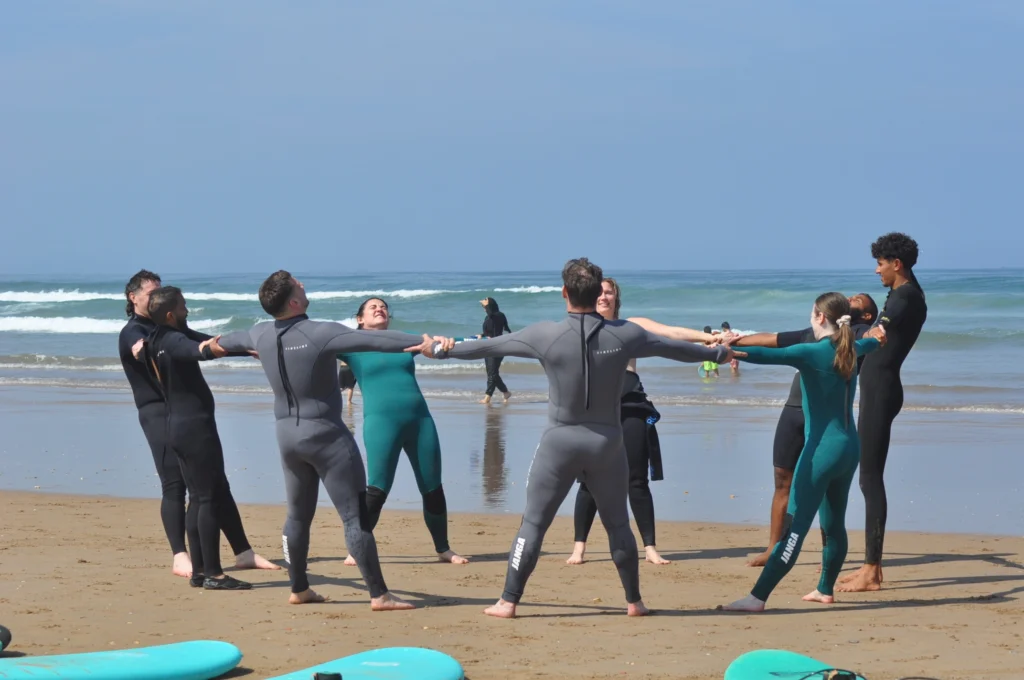
You start on the sand. Your instructor covers where waves break, where the rip channels are, how to carry the board, and how to fall safely. Then you drill the pop-up on dry land until it is muscle memory.
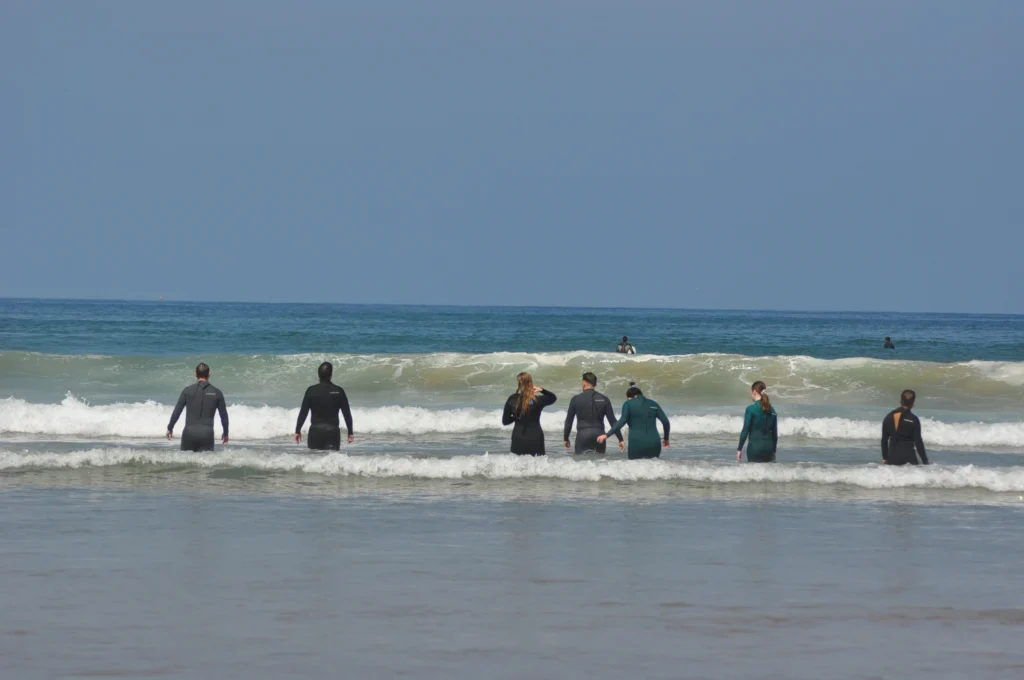
In the water you stay in waist-deep whitewater with the instructor pushing you into waves. Expect to catch a lot of them and to stand up somewhere between wave five and wave twenty. Most people manage it on day one.
Day 2: Catch More Waves
Day two is about volume. You will be sore, and the temptation is to take it easy — don’t. This is the session where standing up stops being a fluke and starts being repeatable.
You move slightly deeper, start paddling into waves yourself rather than being pushed, and begin working on timing: the wave picks you up only if you are already moving at its speed. Expect more wipeouts than day one. That is progress, not regression.
Day 3: Build Confidence
By day three you are catching waves independently and riding them to the beach. Good instructors use this session to add board control — angling your take-off, staying on the fastest part of the wave — and often take you slightly further out to attempt a green wave.
Many camps film day three and run a video review afterwards. If yours offers it, take it. Seeing your own pop-up is worth three verbal corrections.
Why Learn to Surf in Morocco?
For anyone flying from the UK, the case to learn to surf in Morocco is straightforward.
It is genuinely close. Direct flights to Agadir run from Gatwick, Stansted, Luton, Manchester, Leeds, and Bristol with easyJet, Jet2, TUI, Ryanair, and British Airways. Gatwick to Agadir takes under four hours. Note that several of these are seasonal winter-sun routes running roughly October to April, so check availability if you are travelling in high summer.
There is no real time difference — Morocco matches UK time in summer and sits an hour ahead in winter — so a Thursday-night flight and a Monday-morning return gives you three clean surf days with no jet lag.
British passport holders do not need a visa for stays up to 90 days.
It works when the UK doesn’t. Between November and March the British coast is cold, dark, and often too big for a beginner. Morocco in the same window is 20 °C on land with waves every day.
It costs very little. A two-hour group lesson with a proper school is around £20–32. A private lesson runs roughly £40–65.
Beginner-Friendly Surf Spots in Morocco
Almost everyone who comes to learn to surf in Morocco does it on the stretch of coast between Agadir and Imsouane, which has an unusual concentration of forgiving, sand-bottomed waves:
- Banana Beach and Croco Beach, Tamraght — soft, sandy, and the default classroom for almost every school in the region
- Devil’s Rock, Tamraght — slightly more shape once you can stand
- Imsouane Bay — a long, slow right-hander that lets a near-beginner ride for hundreds of metres
- Agadir Bay — sheltered, and the reliable fallback on days when a big swell shuts everything else down
Best Places to Learn to Surf in Morocco
Tamraght is the best place to learn to surf in Morocco on a three-day trip. It is quiet, walkable, and sits directly next to the gentlest waves on the coast.
Taghazout, ten minutes north, has more schools, more places to eat, and more of a social scene. Choose it if you want company in the evenings, but be aware that lessons still happen at the Tamraght beaches.
Imsouane is a better second trip than a first one brilliant once you can already paddle and stand.
What Do You Need for 3 Days of Surf Lessons?
Surfboard and Wetsuit
Both are included in essentially every package to learn to surf in Morocco, so bring nothing. Beginners ride large soft-top foam boards, which are stable and safe if they hit you. Wetsuit thickness is 3/2 mm from roughly October to May, and a shorty or nothing at all in July and August.
What you do need to pack: swimwear, a rash vest if your skin marks easily, reef-safe sun cream, a towel, sunglasses, and a refillable water bottle. The Atlantic sun is stronger than it feels in a breeze.
One UK-specific point: your GHIC is not valid in Morocco. Take travel insurance that explicitly covers surfing — many standard policies exclude watersports unless you tick the box.
Surf Safety and Instructor Support
Wherever you learn to surf in Morocco, ask three questions before booking: is the instructor ISA-certified or equivalent, how many students are in the group, and is there a water-safety person in the line-up. Six to eight students per instructor is the sensible maximum for beginners; twelve means you will spend the session queueing.
Rip currents are the main genuine hazard, not the waves. A decent school briefs you on how to spot one and how to get out of it on day one, and keeps you inside a marked area. If nobody mentions rips, book elsewhere.
How to Get the Most From 3 Days of Surfing
Three days is short, so the gap between a great trip and a wasted one comes down to a few decisions. If you only have one long weekend to learn to surf in Morocco, do these things:
- Book consecutive mornings. Wind is usually lightest early, and the waves are cleaner.
- Do not skip day two. It is the least fun and the most important.
- Add one private session. An hour of one-to-one on day two or three is worth more than two extra group lessons.
- Rent a foamie between lessons. Even 30 minutes of unsupervised whitewater doubles your wave count.
- Stay near the beach so you are not spending your short trip in a minibus.
- Ask for video feedback if it is offered.
- Go between May and September if you are a total beginner — smaller, cleaner waves and warmer water.
Learn to Surf in Morocco in 3 Days: FAQ
Is 3 days enough for a complete beginner?
Yes, to stand up and ride broken waves confidently. No, to surf independently. Three days is the standard length for a beginner course precisely because it covers the first breakthrough without overreaching.
Can I learn to surf in Morocco without experience?
Absolutely. No previous board sport experience is needed. The only real requirement is being comfortable swimming in the sea — you should be able to manage 50 metres and stay calm out of your depth.
What is the best place to learn to surf in Morocco?
Tamraght, in Taghazout Bay. The beaches there are sandy, gentle, and consistently the best classroom on the coast, with Taghazout ten minutes away if you want more going on in the evenings.
Ready to Learn to Surf in Morocco?
Three days, four hours from the UK, warm water, and waves that are actually designed for learning. It is about as easy as a first surf trip gets.
View our 3-day beginner packages → or message us and we’ll check the forecast for your dates →